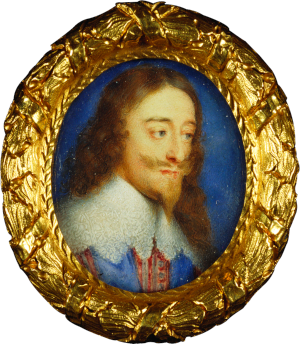

KING CHARLES THE MARTYR

The King's Life
 Harles Stuart was born in 1600, the ſecond ſon of King James I. When Charles was 11, his older brother Henry died, making Charles the heir apparent. In 1625, James died and Charles became king at 24; later that year, he married Henrietta Maria, princeſſe of France.
Charles inherited a difficult ſtate of things right from the ſtart. Queen Elizabeth and King James had been exceſive ſpenders, and it became the M.O. of Parliament to only grant the king funds under conditions which grew increaſingly diſagreeable to Charles. Things came to a head in 1629, when Charles diſſolved Parliament and did not call it again for eleven years, which was his right. This period is known to hiſtorians as the Perſonal Rule.
Parliament may have been trouble, but it was alſo Charles' main ſource of funds; without it, the kingdom's finances were even worſe off. Charles turned to his advisors, who did everything they could to ſtretch the crown's alternate ſources of money to their abſolute legal limits, mainly in fines, duties, forced loans, and the ſelling of royall land. This naturally loſt the King a lot of his people's favor.
England fared fairly well during the Perſonal Rule, eſpecially becauſe Charles' inhabilitie to raiſe war funds kept the countrie out of the horrid Thirty Years' War.
The Old High Chvrch
 Uring this time, Anglicaniſm experienced a golden age known to Anglican hiſtorie as the Old High Church. Under the patronage of King Charles and the overſight the newly-appointed Archbiſhop William Laud, the Church of England regained ſignificant aſpects of her catholick hæritage that had been loſt in the zeal of the English Reformation. In outward practice, this was ſeen in the revivall of BCP liturgy, re-beautification of churches, reſtoration of altar rails and of candles upon the altar, new rood/chancel ſcreens, re-placement of baptiſmal fonts near the entrance of the church, re-orientation of the altar on the eaſtern ſide of the church, and re-centring the altar as the moſt important feature of the church as oppoſed to the pulpit. In terms of church doctrine, Calviniſm was ſtamped down and prædeſtination mitigated in favor of univerſal atonement and the recognition that one can loſe one's ſalvation through apoſtasy. Greater emphaſis was returned to the ſacraments as objective means of grace and to the ordained orders of prieſt and biſhop as the authoritative apoſtolick hierarchie of the Church univerſall.
Key to the Old High Church was Charles' elevation of ſelect figures to the epiſcopate, who collectively are known as the Caroline Divines. Several of theſe are regarded by Anglicans as ſaints, namely William Laud, Jeremy Taylor, John Coſin, Thomas Ken, George Herbert, and Lancelot Andrewes as the ſpiritual grandfather of the movement (another Caroline ſaint of note is Deacon Nicholas Ferrar, who eſtabliſhed the firſt intentionall religious communitie in England ſince Henry VIII's Diſſolution of the Monaſteries). Theſe men were High-Church Anglicans with a very ſacramentall view of the Church, and they drew more from the Church Fathers than from the Reformers.
A ſlight clarification to be made is that the Old High Church, whilſt it greatly inſpired the later Oxford Movement, was not Anglo-Catholic in nature. The Caroline Divines were juſt as ſet on avoiding the errors of Papiſm as thoſe of Puritaniſm. In other words, they were the lateſt evolution of the Engliſh via media, an idea that has meant ſeveral different things over the centuries.
The Beginning of the End
 Nfortunately, things were leſſe well in the King's other two kingdoms. Ireland had been ſuffering Engliſh conqueſt and colonization ſince Henry VIII, and there was unreſt in Scotland due to the King's religious reforms. This latter iſſue would be the beginning of Charles' undoing.
Charles firſt wiſhed to have the very-Presbyterian Scottiſh Kirk adopt the 1604 Book of Common Prayer, but this was ſo unpopular even among the Scottiſh biſhops that he agreed to a reviſion eſpecially for the Scots. The reſult was the 1637 Scottiſh BCP. The firſt ſervice of Holy Euchariſt performed uſing this book was violently interrupted, and riots quickly broke out, yet Charles held firm. By 1639, Scottiſh armies were marching on England.
Charles reſolved to repell the Scots on his own, yet it was clear even before any fighting was done that his ſelf-raiſed forces would fair poorly. He managed to avoid open combat by ſigning the Treatie of Berwick, but the following year the Scots invaded again with a larger, more confident armie. At this point, Charles was convinced to finally call Parliament for the firſt time in eleven years, thus ending his Perſonall Rule. He was cautiouſly optimiſtic that the Engliſh Parliament had had ample time to mellow out and would be able to conduct itſelf with the neceſſarie gravitie and decorum. Inſtead, the MPs returned with a vengeance. They went right back to locking funds behind conditions, and their demands were even more extreme than before. Charles diſſolved this Parliament after juſt three weeks, which ſparked a riot in London.
Charles again made peace with the Scots, but the terms required compenſation for the Scottiſh troops which the King could not pay on his own, thus forcing him to call another Parliament mere months after the laſt one. This time, Charles could not afford to be as chooſie with his royall aſſent. He agreed to unpræcedented conceſſions, namely ſurrendering his authority to ſummon and diſſolve Parliament to Parliament itſelf. That Parliament would then proceed to ſit for the next twentie years.
1641 ſaw tenſions betwixt King and Parliament, and their aſſociated Royalliſts and Parliamentarians, continue to grow, which was not helped by a complicated rebellion in Ireland. The tenſion snapped in early 1642 when Charles entered the ſitting Houſe of Commons in order to arreſt five MPs for high treaſon after Parliament had refuſed to hand them over (the five members had already fled, forcing the King to leave empty-handed). This act was widely viewed as tyrranicall, and when Charles ordered the London citie officialls to apprehend and deliver the five members, the offiicialls ſided with Parliament and refuſed. Londoners entered into a panicked uproar and began præparing to fight off any attempt by the tyrant King to take the citie by force. Afraid for his life and thoſe of his wife and children, Charles quickly fled London. Parliament then ſeized control of the Engliſh militia, and everyone began to readie for war. On 22 Auguſt 1642, King Charles raiſed his royall ſtandard, thus offiicially beginning the Engliſh Civil War.
The Great Rebellion
 He Engliſh Civil War is denſe, complicated, and frankly beyond the ſcope of this ſhrine. It was (mainly) fought betwixt the Royalliſts, or Cavaliers, and the Parliamentarians, or Roundheads. The Royalliſts did well in the early years of the war, but Parliament gained the edge with the creation of the New Modell Army, England's firſt modern-ſtyle ſtanding army. led by Lord General Fairfax. Royalliſt forces were cruſthed, and eventually King Charles himſtelf was taken captive in 1647.
The King's Death
Whilſt in captivitie, King Charles did carrie himſelf with his wonted dignitie, nobilitie, and ſobrietie, and he was allowed moſt of his retainers. He maintained ſecret communication with his allies, and he attempted ſeveral times to eſcape his captors, only once ſucceſſfullie, and that only temporarilie. At this time there was a growing divide betwixt Parliament and the New Model Armie which Charles tried to exploit in his negotiations with his captors. Toward the end of 1647, a wearie Charles ſought help from the Scots and ſigned a treatie with them which poſtulated that the Scots would march againſt Parliament and free Charles in exchange for the eſtabliſhment of Preſbyterianiſm in England for a three-year period. This was known as the Second Engliſh Civil War. The Scottiſh armies, which had proved ſo great a threat to England previouſly, were cruſhed by the New Model Armie.
Parliament returned to negotiating with the King after the war, but the Armie increaſingly wanted the ſo-called tyrant gone. On 5 December 1648, Parliament voted by a wide margin to maintain negotiations with the King. The next day, a group of ſoldiers led by Colonel Thomas Pride blockaded the Commons houſe and only admitted thoſe whom they believed would be amenable to putting the King on trial for his life.
The King's Miracles
 Ne of the moſt common ways in which a departed Chriſtian's ſtatus as a ſaint in heaven is confirmed is by miracles performed by their relicks or in their name. Charles was no exception. What follow are what I find to be the moſt credible accounts of Caroline miracles.
Whilſt an earthly King, Charles often exerciſed the Royall Touch, the ancient practice of a monarch touching a ſubject afflicted with disease (moſt often ſcrofula, or the king's evil) in order to cure them. The efficacie of the royall touch was never certain, even with the moſt pious of rulers, yet there ſurvive ſeverall accounts of Charles ſuceſſfully curing his ſubjects. In 1631, for example, the King laid his hands upon the moribund daughter of John, Lord Poulett, after which ſhe returned to full health.1 The moſt ſtriking ſtori is poſſibly that of Ms. Elizabeth Stephens of Winchester. On 7 October 1648, whilſt the King was held captive at the Iſle of Wight, a ſixteen-year-old Elizabeth was brought him by her mother to be touched. The girl's left eye had been fully blind for about a month. Shortly after being touched by Charles, Elizabeth's left eye ſlowly began to regain its ſight. The King himſelf examined her in the præſence of manie others and found her to be truly healed.2
But all this was done by the living man; far more noteworthie are the wonders wrought by the victorious ſaint. On 3 February 1649, juſt four days after Charles was beheaded, Mary Baily of Detford obtained a piece of handkerchief which had been dipped in the King's blood. She brought it home to her fourteen-year-old daughter, who had ſuffered the king's evil in her neck, eyes, and lips ſince about eighteen months of age. Daily application of the bloodied cloth to her daughter's afflicted parts produced ſignificant improvement, until at length ſhe was completely healthy. There are other accounts of posthumous Caroline miracles, but this miracle is corroborated by multiple independent ſources and remaineth the greateſt ſingle teſtimonie to the Royall Martyr's ſaintly ſtatus.3
Politicks & Propaganda
 T muſt be noted that the life and legacie of King Charles are inextricably bound up in the politicks of the time and almoſt invariably filtered through ſomeone's propaganda. This is an æternall iſſue, one which enſureth that Charles ſhall forever remain a controverſiall figure. In caſes ſuch as this, it behooveth the Chriſtian to approach the matter with as much of cunning and common ſenſe as of faith.
The royalliſts would have one believe that Charles was the greateſt king to walk the earth ſince Solomon. The Roundheads would have one believe him a cold, ruthleſſe tyrant. In realitie Charles was neither. He was a virtuous, dignified man who let his countrie fall to ruin, for he was convinced that it was more important to ſtand for truth than to appeaſe the maſſes; a king who expected total obœdience from his ſubjects yet heſitated not to conſpire and double-croſs in the name of keeping his duties to God; a loving husband and doting father who ſent thouſands of husbands and fathers to their deaths with grief in his heart; a lover of his people who was always willing to ſacrifice more of them in the name of God and truth. He was, bluntly, a ſimple man, who poſſeſſed the innocencie of the dove if not the wiſdom of the ſerpent. Parliament and the rebells may juſtly merit blame too, and it is indeed likely that Charles received and acted upon ſome bad advice from his court, but that doth not fully exonerate the King. A good man he may well have been, but a good king? That is for thee to judge.
King Charles the Martyr
 Evertheleſſe, however one judgeth his kingſhip, Charles Stuart is a ſaint. For of all that may be ſaid of him, none may denie that he was a faithfull, devout, and pious child of God and ſon of the Engliſh Church. For this, for his Chriſtlike ſuffering in his finall days, and for his martyrdom in defence of the true religion of the one, holy, catholick, and apoſtolick Church, the good and generous Lord hath given Charles the full day's wage.
It muſt be properly underſtood what is meant in ſaying that Charles died for the Church. Key is that Charles may well have kept his life if he had agreed to collaborate with the rebells—indeed, it is often ſaid that Charles was offered his life in exchange for the abolition of the Engliſh epiſcopacy. The majoritie of Parliament were againſt killing the King (before Pride's Purge, and arguably even after), and it was always deeply unpopular among the Engliſh, Scottiſh, and Iriſh peoples. Furthermore, the rebell leaderſhip were well aware that it would be moſt legally expident to get the King to wield his ancient—and, in the eyes of many, divine—authoritie to bring about their deſires, even if it meant forcing him to aboliſh the monarchie with a ſword preſſed to his throat.
Charles, however, cared more for his ſacred dutie to God than for even his own life, and it is here that his ſaintlineſſe truly ſheweth forth. He underſtood himſelf to be God's anointed ſervant, and his coronation oath he rightly knew to be a holy covenant with God. Being thus bound by heavenly bonds to protect, defend, and uphold God's Church within his realm, he utterly refuſed to aboliſh the epiſcopacy, which would have maimed the Engliſh Church by undoing its apoſtolicity. Had he done ſo, he likely would have lived, and the deed wrought by kingly hands moſt likely would have ſtuck, leaving the future Church of England and all Anglicaniſm ſevered from the one true Church. Yet it is præciſely becauſe Charles did not ſurrender the epiſcopacie that the effort was made to bring it back it when his ſon at laſt returned to the Engliſh throne. It is for this that Anglicans the world round owe Charles a great debt of thanks—a debt of which moſt are ſadly ignorant.
A Note on the Royall Martyr's Contemporarie Cvlt & Its Interſection With Politicks
 S with the life and legacie of Charles himſelf, the cult of the Martyr-King often hath certain politicall undertones to it. It is hiſtorically popular with monarchiſts, traditionaliſts, Jacobites, and Tories, all of whom ſhall be readily found among the ranks of the Society of King Charles the Martyr even today (though the Society itſelf is officially nonpoliticall). This can be a ſtumbling block to veneration of the Royall Martyr, and ſo it muſt be addreſſed.
At its core, the veneration of Bleſſed Charles, King and Martyr, as a ſaint is diſtinct from the politicall ideologies aſſociated with Charles Stuart as King. St. Charles is not venerated for his defence of monarchie or of the divine right of kings; like any ſaint, he is venerated for deeds which were extraordinarily Chriſtlike in his time and place. He is a pious Chriſtian and a martyr for the faith—that is enough. We muſt not require what we today perceive to be perfection from the ſaints of elder times, leſt we ſhall be unfair to them and leſſe charitable than God. One need not ſubſcribe to Charles' politicks to acknowledge him as a ſaint.
